



Schedule
Conference Program
Monday
09:00 – 10:00
Jehanne Dousse
Partition identities, particle motion and lattice paths
Partition identities, particle motion and lattice paths
A partition identity is a theorem stating that for all $n$, the number of partitions of $n$ satisfying some conditions equals the number of partitions of $n$ satisfying some other conditions. For example, the Rogers-Ramanujan identities state that for all $n$, there are as many partitions of $n$ where parts differ by at leat two as partitions of $n$ into parts congruent to $1$ or $4$ modulo $5$. In terms of generating functions, partition identities can often be expressed as q-series identities in the form sum=product. The Andrews-Gordon identities are among the most important $q$-series and partition identities, and generalise the Rogers-Ramanujan identities. Interestingly, while the product side of their $q$-series version is clearly the generating function for partitions with congruence conditions, it is far from obvious that the sum side is the generating function for the partitions with frequency conditions that appear in the combinatorial version. It was originally proved by George Andrews using recurrences, and then bijectively by Ole Warnaar using particle motion, which can be seen as a bijection on lattice paths. In this talk, we will explain and generalise the particle motion approach. We will show that it can also be applied to the sum side of Bressoud's identity and that, using the Andrews-Gordon and Bressoud identities as starting points, many known and new identities can be proved. This is based on joint work with Jihyeug Jang, Frédéric Jouhet and Isaac Konan (see arXiv 2507.13239 and arXiv 2307.02346).
slides
10:00 – 10:30
Pooneh Afsharijoo
Even-odd partition identities of Göllnitz-Gordon type
Even-odd partition identities of Göllnitz-Gordon type
We prove a theorem which adds a new member to the famous Göellnitz-Gordon identities. We construct a "new system of recurrence formulas" in order to prove it. Presentation based on the article arXiv 2403.10189.
slides
10:30 – 11:00
Coffee break
11:00 – 11:30
Krishna Menon
Bouncing canons
Bouncing canons
A canon permutation is a multiset permutation constructed from a pair: a Dyck path and a permutation. This is done by labeling the up-steps and down-steps using the permutation and then reading the Dyck path. We study descents in canon permutations, continuing a line of work initiated by Elizalde.By fixing a Dyck path and varying over all permutations, we associate a descent polynomial to the Dyck path. We study these polynomials and find relations to known statistics on Dyck paths. In particular, the degree of this polynomial is related to peaks in the bounce path. Talk based on a joint work with Danai Deligeorgaki: arXiv 2603.22565. slides
11:30 – 12:00
Élie de Panafieu
Combinatorics of nondeterministic walks
Combinatorics of nondeterministic walks
We introduce nondeterministic walks, a new variant of one-dimensional discrete walks. The main difference from classical walks is that its nondeterministic steps consist of sets of steps from a predefined set, allowing for parallel exploration of all possible extensions. We discuss in detail two particular nondeterministic step sets inspired by Dyck and Motzkin walks and show that several nondeterministic classes of lattice paths, such as nondeterministic bridges, excursions and meanders, are algebraic. We extend our results to general step sets, proving that nondeterministic bridges and several subclasses of nondeterministic meanders are always algebraic, but leaving the case of excursions as a conjecture.This research is motivated by the study of networks involving encapsulation and decapsulation of protocols. Our results are obtained using generating functions, analytic combinatorics and additive combinatorics. Talk based on a joint work with Michael Wallner: arXiv 2311.03234. slides
12:00 – 14:00
Lunch
14:00 – 15:00
Christian Krattenthaler
Refined enumeration of two-rowed set-valued standard tableaux via two-coloured Motzkin paths
Refined enumeration of two-rowed set-valued standard tableaux via two-coloured Motzkin paths
Motivated by previous work of Lazar and Linusson, I consider the refined enumeration of set-valued tableaux of two-rowed shapes. I shall derive formulae for the number of these tableaux, keeping track of the total number of entries, the number of entries in the first row, and the number of entries in the second row. Key in the proofs is a bijection with two-coloured Motzkin paths (which is already present in the work of Lazar and Linusson) followed by generating function computations and coefficient extraction helped by the Lagrange inversion formula. Talk based on arXiv 2501.09208.
slides
15:00 – 15:30
Seok Hyun Byun
A reflection principle for nonintersecting paths and lozenge tilings with free boundaries
A reflection principle for nonintersecting paths and lozenge tilings with free boundaries
Okada and Stembridge's Pfaffian formula for the enumeration of families of nonintersecting paths with fixed starting points and unfixed ending points has been widely used to resolve many challenging problems in enumerative combinatorics. In this talk, we present a new formula that complements Okada and Stembridge's Pfaffian formula. The combinatorial interpretation of the new formula gives a reflection principle for nonintersecting paths. It implies that the enumeration of families of nonintersecting paths with unfixed ending points can be resolved by enumerating families of nonintersecting paths with fixed ending points instead. If time permits, we also explain how the enumeration of lozenge tilings of a large family of regions with free boundaries can be deduced from those without free boundaries, and present several applications of this result. Talk based on arXiv 2508.12135.
slides
15:30 – 16:00
Photo + Coffee break
16:00 – 18:00
Poster session
Poster session
- $\top$-avoiding rectangulations, inversion sequences, and rushed Dyck paths — Andrei Asinowski poster
- Partial degenerate Stirling numbers — Beáta Bényi poster
- On (3, 1)-regular graphs with one more vertex than edges: a case study in difference-differential algebra — Frédéric Chyzak poster
- Symmetric statistics on rational Dyck paths — Lilan Dai poster
- Rectangle partitions generalizing integer partitions — Krystian Gajdzica poster
- Off-diagonally symmetric alternating sign matrices — Nishu Kumari poster
- A continuous kernel method for affine Motzkin paths — Alexander Omelchenko poster
- Steady-state and absorption probabilities of common Markov chains — Gerardo Rubino poster
- Lattice paths and the enumeration for stacks of protein contact maps — Lisa Hui Sun poster
- Charalambos A. Charalambides (1945–2024), $q$-distributions, and advances in $q$-order statistics — Malvina Vamvakari poster
- Congruences for hook lengths of partitions and paths in the Young lattice — David Wahiche poster
- Immanant positivity for Catalan-Stieltjes matrices — Arthur L. B. Yang poster
- Macdonald polynomials and e-positivity — Meesue Yoo poster
18:00 – 20:00
Reception at TU Wien
Tuesday
09:00 – 10:00
Ecaterina Sava-Huss
Entropy and speed of branching random walks
Entropy and speed of branching random walks
We consider supercritical branching random walks (BRW) on infinite graphs, and we investigate the limit behavior of the population distributions. In particular, we look at the speed and the asymptotic entropy of such processes. Both these quantities describe non-trivial behavior at infinity of the BRW. We show that the entropy exhibits a phase transition depending on the underlying random walk. This talk is based on past and ongoing works in collaboration with J. Brieussel, R. Kaiser, M. Klötzer, K. Kolesko, and H. Oppelmayer (arXiv 2603.13025).
slides
10:00 – 10:30
Greg Warrington
Quantized rational chip-firing
Quantized rational chip-firing
In this talk we introduce a new chip-firing model that makes close contact with the combinatorics of labeled and unlabeled rational-slope lattice paths. In generalizing the classic model, we extend chip-firing to graphs with rational edge weights while extending a number of important properties such as duality between superstable and recurrent configurations, enumerative results relating to the Catalan numbers and parking functions, and the existence of an associated critical group. Rational parking functions appear as the lattice-path analogues of those configurations on the complete graph that are supserstable with respect to this quantized rational chip-firing model. Talk based on a joint work with Spencer Backman and Nick Loehr; see arXiv 2603.15451. slides
10:30 – 11:00
Coffee break
11:00 – 11:30
Moritz Gangl
Two Littlewood identities for fully inhomogeneous spin Hall-Littlewood symmetric rational functions
Two Littlewood identities for fully inhomogeneous spin Hall-Littlewood symmetric rational functions
The fully inhomogeneous spin Hall-Littlewood symmetric rational functions are the partition functions of tuples of lattice paths consisting of north and east steps with certain boundary conditions in the $\mathfrak{sl}_2$ higher spin six vertex model. For a special choice of the parameters in the vertex weights, we obtain tuples of non-intersecting lattice paths and show that these are in bijection with rectangular alternating sign matrices. We present two new Littlewood identities for the fully inhomogeneous spin Hall-Littlewood symmetric rational functions, generalising various known identities for Schur polynomials, Hall-Littlewood P polynomials and the modified Robbins polynomials. This is joint work with Ilse Fischer from the University of Vienna: arXiv 2603.29836.
slides
11:30 – 12:00
Axel Bacher
Progressive and rushed Dyck paths
Progressive and rushed Dyck paths
Progressive paths and rushed paths are two families of Dyck paths studied by Asinowski and Jelínek, which have the same enumerating sequence (OEIS entry A287709). I will present a bijection proving this fact. Rushed paths turn out to be in bijection with one-sided trees, introduced by Durhuus and Ünel, which have an asymptotic enumeration involving a stretched exponential. I will show some asymptotic results and present a random sampling procedure for rushed paths. I will conclude by presenting several other classes of related lattice paths and directed animals that may have similar asymptotic properties. Talk based on arXiv 2403.08120.
slides
12:00 – 14:00
Lunch
Wednesday
09:00 – 10:00
Marni Mishna
One step beyond: differential transcendence and excursions on fractals
One step beyond: differential transcendence and excursions on fractals
Enumerative and probabilistic properties about the set of walks on a graph can reveal important algebraic and combinatorial information about the graph and any object it encodes. In this talk we consider the types of equations satisfied by series related to excursions on graphs, taking both analytic and combinatorial perspectives. Looking at examples from Cayley graphs and families of self-similar graphs we try to identify hallmarks of algebraicity and differential transcendence. The context provides an excellent illustration of dichotomy results for order 1 iterative equations: solutions to these equations are either algebraic or differentially transcendental. (Work done in collaboration with Lucia Di Vizio, Gwladys Fernandes, and Yakob Kahane; see arXiv 2309.07680 and arXiv 2411.19316).
slides
10:00 – 10:30
Juan Pulido
On the small-step quarter plane lattice walks with a non D-finite univariate generating function
On the small-step quarter plane lattice walks with a non D-finite univariate generating function
We address the Bousquet-Mélou-Mishna conjecture, which predicts that the counting generating function $Q(1,1;t)$ of a small-step quarter-plane lattice model is D-finite if and only if the group of the walk is finite. The finite-group case is complete, and the infinite-group result for the multivariate endpoint generating function $Q(x,y;t)$ has recently been resolved. However, the specialization to $Q(1,1;t)$ remains open in general. We organize the infinite-group models according to what is known and conjectured about its non-D-finiteness.For $21$ of the $56$ infinite-group models — the five singular models, three with zero drift, and thirteen with polar interior drift — non-D-finiteness follows from asymptotic results of Bostan–Raschel–Salvy and probabilistic estimates of Denisov–Wachtel and Duraj. Nine further models have differentially algebraic endpoint generating functions via decoupling functions, though their D-finiteness remains open. For 21 additional models, we propose a new approach based on numerical estimates of singular exponents of the boundary series $Q(1,0;t)$ and $Q(0,1;t)$, and state conjectures toward completing the classification. We also discuss ongoing progress toward proving some of these conjectures. Talk based on a joint work with Marni Mishna: arXiv 2605.16688. slides
10:30 – 11:00
Coffee break
11:00 – 11:30
Pierre Bonnet
Tutte's invariant method and algebraicity of large steps walks
Tutte's invariant method and algebraicity of large steps walks
The enumeration of walks in the quarter plane confined in the first quadrant has attracted a lot of attention over the past twenty years. The generating functions associated to small steps models satisfy a functional equation in two catalytic variables. For such models, Bousquet-Mélou and Mishna, along Fayolle, Iasnogorodski and Malyshev defined a group called the group of the walk which turned out to be central in the classification of small steps models. In particular, its action on the catalytic variables yields a set of change of variables compatible with the structure of the functional equation. This particular set called the orbit has been generalized to models with arbitrary large steps by Bostan, Bousquet-Mélou and Melczer, with no underlying group. In this talk, I will explain how one can endow the orbit with the action of a Galois group, which extends the group of the walk to models with large steps. The talk will then focus on the first major application of this Galoisian framework to the study of walks, that is a generic algebraicity strategy for walks with small backwards steps. This strategy is based Tuttes invariants method, introduced by Bernardi, Bousquet-Mélou and Raschel. Namely, the galois theoretic formulation allows for a complete characterization and contruction of rational invariants and decouplings, that are crucial for this strategy. In the end, this allows to prove the algebraicity of many models with large steps. Talk based (in part) on a joint work with Charlotte Hardouin: arXiv 2409.11084.
slides
11:30 – 12:00
Manfred Buchacher
A differential analogue of Tutte's invariant method
A differential analogue of Tutte's invariant method
Tutte’s invariant method as introduced by Mireille Bousquet-Mélou, Olivier Bernardi and Kilian Raschel provides uniform algebraicity proofs for generating functions of restricted lattice walks. Whether it applies or not very much relies on the existence of rational functions that are called invariants and decoupling functions. I will present the ideas that underly Tutte's invariant method, explain how invariants can be constructed, and discuss a differential analogue that relies on invariants only. Talk based (in part) on a joint work with Charlotte Hardouin, and on earlier work: arXiv 2411.08584.
slides
12:00 – 14:00
Lunch
14:00 – 15:00
Igor Pak
Combinatorics and computational complexity of counting coincidences
Combinatorics and computational complexity of counting coincidences
Say, you are counting certain combinatorial objects. What is the range of the numbers you get? Do you ever get coincidences? If yes, how many? How hard is it to tell if you have a coincidence? I will discuss the coincidence problem for counting domino tilings, spanning trees and independent sets in graphs, linear extensions in posets, permutation patterns, and Young tableaux. I will also make a number of curious counting conjectures. Talk based on a joint work with Swee Hong Chan, arXiv 2308.10214.
slides
15:00 – 15:30
Gábor Hetyei
Lattice paths and the toric g-vector of nestohedra
Lattice paths and the toric g-vector of nestohedra
In a recent paper with Richard Ehrenborg and Margaret Readdy (arXiv 2511.04815), we expressed the toric $g$-vector entries of any simple polytope as a nonnegative integer linear combination of its gamma-vector entries. We showed that the toric $g$-vector of the associahedron is the ascent statistic of all 123-avoiding parking functions. An analogous result holds for the cyclohedron and 123-avoiding functions. We also proved that the toric $g$-vector of the permutahedron records the ascent statistics of parking trees representing 123-avoiding parking functions. Our approach extends to all chordal nestohedra. In this talk we will focus on the associahedron, where our proof relies on pairing the Dyck path representation of a parking function by Garsia and Haiman with the Dyck path representation of a 123-avoiding permutation by Krattenthaler.
slides
15:30 – 16:00
Coffee break
16:00 – 16:30
Michael Drmota
Combinatorics and asymptotics of systems of positive linear catalytic equations
Combinatorics and asymptotics of systems of positive linear catalytic equations
We provide a complete combinatorial and asymptotic analysis of positive linear systems of equations in one catalytic variable that appear in several combinatorial problems, such as lattice-path counting or stack-sortable permutation counting. We show that the corresponding generating functions satisfy a positive polynomial system of equations (which is associated to a context-free grammar). Furthermore we prove a universal asymptotic behaviour. Talk based on joint work with Cyril Banderier: arXiv 2605.22241.
slides
16:30 – 17:00
Martin Klazar
Extending the symbolic method in enumerative combinatorics
Extending the symbolic method in enumerative combinatorics
In the classical symbolic method, one is given a countable family $A$ of combinatorial objects, a size function $s$, and a weight function $h$ from $A$ to a ring $R$. The coefficients in the generating function corresponding to $A$, $s$, and $h$ are defined as the finite sums of $h$-weights of objects $a \in A$ with fixed size $s(a)=n$. In our extension of the symbolic method, we drop the finiteness condition, and we only require that the ring R is endowed with a complete norm and that every coefficient sum absolutely converges. We exemplify our extension on generalizations of classical Pólya's theorem about random walks in the d-dimensional grid. Talk based on a joint work with Richard Horský: arXiv 2511.00914.
slides
17:00 – 18:00
Open problem session
18:00 – 19:00
Bus to conference dinner
Bus to conference dinner
The dinner takes place 19:00 – 22:30 at the Heuriger Fuhrgassl-Huber, Neustift am Walde 68, 1190 Wien.
Busses depart to restaurant at 18:30 (sharp). The bus will be waiting at Operngasse 14. Please arrive there at 18:20. 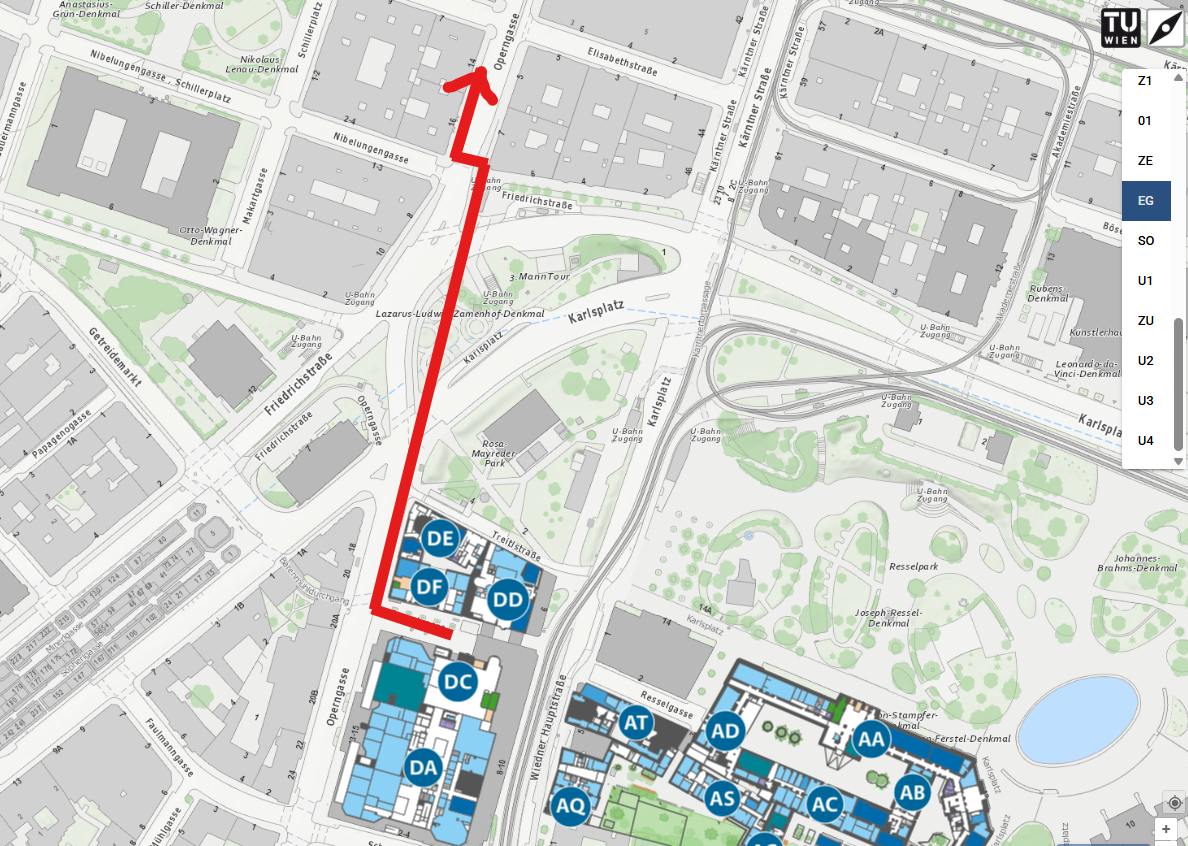
19:00 – 22:30
Conference dinner
at the Heuriger Fuhrgassl-Huber
at the Heuriger Fuhrgassl-Huber
Conference dinner
at the Heuriger Fuhrgassl-Huber
The conference diner will be in a "Heuriger". This a traditionnal Austrian tavern (with benches in the garden) where local winemakers serve their new wine. These places are renowned for their atmosphere of "Gemütlichkeit" (a feeling of warmth and friendliness). People share there a bench, and enjoy young wine, simple food, endless discussions... The tradition of Heurigen (plural of Heuriger) is inscribed in the UNESCO intangible cultural heritage list.
at the Heuriger Fuhrgassl-Huber
22:30 – 23:15
Buses back to TU Wien
Buses back to TU Wien
Return buses depart from the original drop-off point to TU Wien (Karlsplatz), connecting to the U1, U2, and U4 subway lines, as well as local buses and trams. - Bus 1 leaves at 22:30
- Bus 2 leaves at 22:45
Thursday
09:00 – 10:00
Luc Vinet
Bispectral algebras and special functions
Bispectral algebras and special functions
Bispectral problems ask for functions that are simultaneously eigenfunctions of an operator in a variable and of another operator in the dual (degree or label) variable. This talk offers a spiral tour through the algebraic structures that organize such problems. Beginning with Leonard pairs (the finite-dimensional paradigm in which the two operators close into a quadratic algebra), we recall how the classical orthogonal polynomials of the Askey scheme arise as overlaps between two eigenbases, with Racah and Hahn as guiding examples. This leads to the Askey–Wilson, Racah and Bannai–Ito algebras and to the classification of Leonard pairs, and to their appearance in the Terwilliger algebras of $P$- and $Q$-polynomial association schemes, illustrated by the Johnson scheme. We then show how these algebras are realized in models: the Racah algebra as the symmetry algebra of the generic superintegrable model on the two-sphere through intermediate Casimirs in threefold products of $\mathfrak{su}(2)$, and the Bannai--Ito algebra through $\mathfrak{osp}(1|2)$, Dunkl operators and $-1$ polynomials. Higher-rank extensions yield multivariate Racah polynomials. The final turns of the spiral connect this picture to algebraic Heun operators, to entanglement of free fermions and time--band limiting on graphs, and to bispectral rational functions, indicating how combinatorial and analytic threads are woven together by these algebras. Talk partly based on arXiv 2605.19475, arXiv 2601.15052, and arXiv 2309.16016.
slides
10:00 – 10:30
Menghao Qu
The $q,t$-symmetry of (area, depth) for $\vec{k}$-Dyck paths
The $q,t$-symmetry of (area, depth) for $\vec{k}$-Dyck paths
The study of $q,t$-Catalan polynomials is a central topic in algebraic combinatorics, deeply connected to statistics on Dyck paths. In 2021, Pappe, Paul, and Schilling introduced two novel statistics, depth and ddinv, for classical Dyck paths, elegantly establishing the $q,t$-symmetry of the joint distributions of (area, depth) and (dinv, ddinv) via involutions on plane trees. In this talk, guided by the observation that depth is essentially a variant of Xin and Zhang's earlier bounce statistic, we extend this concept to the broader framework of $\vec{k}$-Dyck paths. We establish the $q,t$-symmetry of (area, depth) for these paths, which, as a byproduct, yields an alternative interpretation of the higher $q,t$-Catalan polynomials. Talk based on joint work with Yingrui Zhang: arXiv 2510.08196.
slides
10:30 – 11:00
Coffee break
11:00 – 11:30
Matthias Müller
A combinatorial model for the canonical join complex of alt $\nu$-Tamari lattices
A combinatorial model for the canonical join complex of alt $\nu$-Tamari lattices
Alt $\nu$-Tamari lattices constitute a remarkable family of lattices associated with lattice paths that broadly generalize the Dyck and Tamari lattices. To systematically study the structural properties of this family, we introduce a combinatorial model that realizes the canonical join complex of alt $\nu$-Tamari lattices. Serving as a universal tool, this model allows us to prove vertex decomposability, establish an explicit shelling order, and reveal the underlying homology of the canonical join complex of alt $\nu$-Tamari lattices. Talk based on arXiv 2605.13770.
slides
11:30 – 12:00
Khaydar Nurligareev
Brick wall excursions: combinatorial interpretation of random flight moments
Brick wall excursions: combinatorial interpretation of random flight moments
Consider a short uniform random walk in $\mathbb{R}^d$ that starts at the origin and consists of $m$ independent unit steps in random directions (this walk is also known in the literature as random flights). Take the distance to the origin (after $m$ such steps) and compute a sequence of its even moments. As was shown in 2015 by Borwein, Straub, and Vignat, in dimensions $d=2$ and $d=4$, this is an integer sequence. While for $d=2$, the $2n$th moment is equal to the number of abelian squares of length $2n$ over an alphabet with $m$ letters, for $d=4$ no interpretation was known.The aim of this talk is to provide such an interpretation, both for $d=2$ and $d=4$, in terms of $2n$-step lattice paths in dimension $m-1$. Our construction relies on a bijection between Dyck paths with a prescribed number of peaks and words of a certain type. In addition, this bijection allows us to derive closed formulas for the number of lattice paths provided with certain statistics. Talk based on a work with Sergey Kirgizov and Michael Wallner: arXiv 2605.16715. slides
12:00 – 14:00
Lunch
14:00 – 15:00
Gordon Slade
Crossover from subcritical to critical decay: random walk, self-avoiding walk, percolation
Crossover from subcritical to critical decay: random walk, self-avoiding walk, percolation
The study of critical phenomena in lattice statistical mechanical models such as percolation has a long history in both physics and mathematics. A central problem is to derive the asymptotic behaviour of a model's two-point function, which reveals the values of critical exponents that govern the universal behaviour of the model at and near its critical point. Proofs are typically available only for dimension two, or above an upper critical dimension where mean-field behaviour is observed. The talk presents a general theorem providing the asymptotic decay of the solution to convolution equations of a certain sort. It applies to the lattice Green function (random walk in any dimension d), the generating function for the number of n-step self-avoiding walks from 0 to x (d at least 5), the probability that 0 and x are connected in a percolation cluster (high enough d). The general theorem gives a precise asymptotic formula for the decay of the two-point function in these three applications, which remains valid both in the subcritical regime (Ornstein-Zernike decay) and also at and near the critical point. It exhibits, in a unified and general way, the crossover from subcritical to critical decay. This is joint work with Yucheng Liu (Peking University): arXiv 2605.15545.
slides
15:00 – 15:30
Mudit Aggarwal
On groups with D-finite cogrowth series
On groups with D-finite cogrowth series
The cogrowth series of a group with respect to a finite generating set is an important combinatorial quantity that seems very difficult to compute exactly, as evidenced by the scarcity of known examples. In this work, we give a particular infinite family of presentations for which the cogrowth series can be determined as the constant term of an algebraic function, which shows that it is D-finite and, with more work, not algebraic. Our proof exploits the fact that for a particular choice of subgroup, the corresponding Schreier graph has finite tree width, and by considering paths in the cosets and the Schreier graph separately, we are able to construct a system of generating functions which count paths. We find the asymptotics of this system to conclude that the groups have D-finite but non-algebraic cogrowth series. Talk based on a joint work with Murray Elder and Andrew Rechnitzer: arXiv 2605.12793.
slides
15:30 – 16:00
Coffee break
16:00 – 16:30
Florian Schager
A bijection between stacked directed polyominoes and Motzkin paths with catastrophes
A bijection between stacked directed polyominoes and Motzkin paths with catastrophes
We present a novel bijection between stacked directed polyominoes and Motzkin paths with catastrophes. Further, we leverage this new bridge between these two worlds to obtain a better understanding of certain parameters of stacked directed animals. In particular, we obtain improved lower and upper bounds on the asymptotic width of stacked directed animals. This is joint work with Michael Wallner: arXiv 2406.16417.
slides
16:30 – 18:00
In memoriam session
The conference traditionally honors members of the lattice-path community who have sadly passed away since the previous edition. On this occasion, we will say a few words about the work of Charalambos A. Charalambides, Adrienne Kemp, Guy Louchard, Jean-Guy Penaud, and Renzo Sprugnoli.
slides
18:00 – 20:00
Social event
Friday
09:00 – 10:00
Markus Kuba
Composition schemes, lattice paths and card guessing
Composition schemes, lattice paths and card guessing
A great many combinatorial structures are counted by generating functions satisfying a composition scheme $F(z)=G(H(z))$, also known as a Gibbs partition model. I will discuss critical schemes, where the corresponding asymptotic analysis becomes challenging because the generating functions G and H are simultaneously singular. These schemes are naturally related to lattice paths, random walks and a lot of other combinatorial structures. For an extension of the form $F(z,u)=G(u H(z))M(z)$, a rich variety of limit laws is obtained, involving mixed Poisson-, Boltzmann-, and generalized Mittag-Leffler distributions. An enriched model of this scheme links to to various phenomena observed in the combinatorial and statistical physics literature in the context of q-enumeration. In particular, an application is given to zero contacts in non-intersecting lattice paths called watermelons. Furthermore, I will present a new regime for critical schemes related to families of lattice paths in cube, including simple walks and three-dimensional Delannoy walks. Finally, connections between lattice paths enumeration, card guessing procedures and lattice paths in the quarter plane are presented. Talk based on articles with Cyril Banderier, Niccolò Bosio, Alois Panholzer, Benedikt Stufler, Stephan Wagner, and Michael Wallner (see e.g. arXiv 2311.17226 and arXiv 2411.03930). slides
10:00 – 10:30
Hexuan Liu
A combinatorial framework for the Pons-Batle identity: Young tableaux, lattice paths, and limit laws
A combinatorial framework for the Pons-Batle identity: Young tableaux, lattice paths, and limit laws
Tree-child networks form an important subclass of phylogenetic networks, used to model reticulate evolutionary processes. The Pons-Batle conjecture asserts an identity between a class of words of length $2n+k$ and the set of tree-child networks with $n$ leaves and $k$ reticulation nodes. Although the conjecture has been proved by computational methods, a combinatorial explanation is still missing.In this talk, we study this conjecture through lattice paths and generating functions. We associate the relevant objects with two distinct families of lattice paths, and translate the resulting path models into generating functions. Using differential operators for one family and a recursive algorithm based on the number of reticulation nodes for the other family, we obtain an alternative verification of the conjecture for all fixed $k \le 250$.
All these generating functions are algebraic and the asymptotic properties of the associated sequences can be analyzed using singularity analysis. In particular, we can analyze the limit laws of several natural parameters of the networks. In the cases we consider, the limiting distributions are Beta and Uniform distributions.
Talk based on joint work with Guan-Ru Yu (National Sun Yat-sen University) and Michael Wallner (TU Wien): arXiv 2605.07587. slides
10:30 – 11:00
Coffee break
11:00 – 11:30
Martin Rubey
On the global dimension of Nakayama algebras
On the global dimension of Nakayama algebras
We show that the global dimension of linear Nakayama algebras has the same distribution as the height of Dyck paths. To do so, we consider a slight modification of Ringel's resolution quiver and a mix of enumerative and bijective arguments. Talk based on a joint work with Viktória Klász, René Marczinzik, Anton Mellit, and Christian Stump: arXiv 2503.18415.
slides
11:30 – 12:00
Eva-Maria Hainzl
Tree walks
Tree walks
What happens when lattice paths are replaced by walks on a branching structure? Tree walks are a family of combinatorial objects whose enumeration is closely connected to moment calculations in random matrix theory. While the underlying definition is simple, the resulting counting problems are remarkably rich and many questions remain unresolved. In this talk, I will introduce tree walks, explain their connection to spectral distributions of random matrices, and survey recent results and open problems. The talk is based on arXiv 2405.08347 and arXiv 2508.08865.
slides