





10th International Conference on Lattice Path Combinatorics and Applications 2026 (LPC 2026)


Scientific committee
- George Andrews (Pennsylvania State University)
- Cyril Banderier (CNRS/University Sorbonne-Paris-Nord): cochair
- Mireille Bousquet-Mélou (CNRS/University Bordeaux)
- Vít Jelínek (Charles University)
- Greta Panova (University of Southern California)
- Malvina Vamvakari (Harokopio University of Athens)
- Michael Wallner (TU Graz/TU Wien): cochair
- Mei Yin (University of Denver)
Organizing committee
- Nadja Azzouz (TU Wien)
- Cyril Banderier (CNRS/University Sorbonne-Paris-Nord)
- Philipp Beltran (TU Wien)
- Niccolò Bosio (TU Wien)
- Zéphyr Salvy (TU Wien)
- Michael Wallner (TU Graz/TU Wien)
- Secretary: Eva Zuber (TU Wien)
Invited speakers
- Jehanne Dousse (University of Geneva/CNRS): Partition identities, particle motion and lattice paths
slides
abstract
A partition identity is a theorem stating that for all $n$, the number of partitions of $n$ satisfying some conditions equals the number of partitions of $n$ satisfying some other conditions. For example, the Rogers-Ramanujan identities state that for all $n$, there are as many partitions of $n$ where parts differ by at leat two as partitions of $n$ into parts congruent to $1$ or $4$ modulo $5$. In terms of generating functions, partition identities can often be expressed as q-series identities in the form sum=product. The Andrews-Gordon identities are among the most important $q$-series and partition identities, and generalise the Rogers-Ramanujan identities. Interestingly, while the product side of their $q$-series version is clearly the generating function for partitions with congruence conditions, it is far from obvious that the sum side is the generating function for the partitions with frequency conditions that appear in the combinatorial version. It was originally proved by George Andrews using recurrences, and then bijectively by Ole Warnaar using particle motion, which can be seen as a bijection on lattice paths. In this talk, we will explain and generalise the particle motion approach. We will show that it can also be applied to the sum side of Bressoud's identity and that, using the Andrews-Gordon and Bressoud identities as starting points, many known and new identities can be proved. This is based on joint work with Jihyeug Jang, Frédéric Jouhet and Isaac Konan (see arXiv 2507.13239 and arXiv 2307.02346). - Christian Krattenthaler (University of Vienna): Refined enumeration of two-rowed set-valued standard tableaux via two-coloured Motzkin paths
slides
abstract
Motivated by previous work of Lazar and Linusson, I consider the refined enumeration of set-valued tableaux of two-rowed shapes. I shall derive formulae for the number of these tableaux, keeping track of the total number of entries, the number of entries in the first row, and the number of entries in the second row. Key in the proofs is a bijection with two-coloured Motzkin paths (which is already present in the work of Lazar and Linusson) followed by generating function computations and coefficient extraction helped by the Lagrange inversion formula. Talk based on arXiv 2501.09208. - Markus Kuba (FH-Technikum Wien): Composition schemes, lattice paths and card guessing
slides
abstract
A great many combinatorial structures are counted by generating functions satisfying a composition scheme $F(z)=G(H(z))$, also known as a Gibbs partition model. I will discuss critical schemes, where the corresponding asymptotic analysis becomes challenging because the generating functions G and H are simultaneously singular. These schemes are naturally related to lattice paths, random walks and a lot of other combinatorial structures. For an extension of the form $F(z,u)=G(u H(z))M(z)$, a rich variety of limit laws is obtained, involving mixed Poisson-, Boltzmann-, and generalized Mittag-Leffler distributions.
An enriched model of this scheme links to to various phenomena observed in the combinatorial and statistical physics literature in the context of q-enumeration. In particular, an application is given to zero contacts in non-intersecting lattice paths called watermelons. Furthermore, I will present a new regime for critical schemes related to families of lattice paths in cube, including simple walks and three-dimensional Delannoy walks. Finally, connections between lattice paths enumeration, card guessing procedures and lattice paths in the quarter plane are presented. Talk based on articles with Cyril Banderier, Niccolò Bosio, Alois Panholzer, Benedikt Stufler, Stephan Wagner, and Michael Wallner (see e.g. arXiv 2311.17226 and arXiv 2411.03930). - Marni Mishna (Simon Fraser University): One step beyond: differential transcendence and excursions on fractals
slides
abstract
Enumerative and probabilistic properties about the set of walks on a graph can reveal important algebraic and combinatorial information about the graph and any object it encodes. In this talk we consider the types of equations satisfied by series related to excursions on graphs, taking both analytic and combinatorial perspectives. Looking at examples from Cayley graphs and families of self-similar graphs we try to identify hallmarks of algebraicity and differential transcendence. The context provides an excellent illustration of dichotomy results for order 1 iterative equations: solutions to these equations are either algebraic or differentially transcendental. (Work done in collaboration with Lucia Di Vizio, Gwladys Fernandes, and Yakob Kahane; see arXiv 2309.07680 and arXiv 2411.19316). - Igor Pak (University of California, Los Angeles – UCLA): Combinatorics and computational complexity of counting coincidences
slides
abstract
Say, you are counting certain combinatorial objects. What is the range of the numbers you get? Do you ever get coincidences? If yes, how many? How hard is it to tell if you have a coincidence? I will discuss the coincidence problem for counting domino tilings, spanning trees and independent sets in graphs, linear extensions in posets, permutation patterns, and Young tableaux. I will also make a number of curious counting conjectures. Talk based on a joint work with Swee Hong Chan, arXiv 2308.10214. - Ecaterina Sava-Huss (University of Innsbruck): Entropy and speed of branching random walks
slides
abstract
We consider supercritical branching random walks (BRW) on infinite graphs, and we investigate the limit behavior of the population distributions. In particular, we look at the speed and the asymptotic entropy of such processes. Both these quantities describe non-trivial behavior at infinity of the BRW. We show that the entropy exhibits a phase transition depending on the underlying random walk. This talk is based on past and ongoing works in collaboration with J. Brieussel, R. Kaiser, M. Klötzer, K. Kolesko, and H. Oppelmayer (arXiv 2603.13025). - Gordon Slade (University of British Columbia): Crossover from subcritical to critical decay: random walk, self-avoiding walk, percolation
slides
abstract
The study of critical phenomena in lattice statistical mechanical models such as percolation has a long history in both physics and mathematics. A central problem is to derive the asymptotic behaviour of a model's two-point function, which reveals the values of critical exponents that govern the universal behaviour of the model at and near its critical point. Proofs are typically available only for dimension two, or above an upper critical dimension where mean-field behaviour is observed. The talk presents a general theorem providing the asymptotic decay of the solution to convolution equations of a certain sort. It applies to the lattice Green function (random walk in any dimension d), the generating function for the number of n-step self-avoiding walks from 0 to x (d at least 5), the probability that 0 and x are connected in a percolation cluster (high enough d). The general theorem gives a precise asymptotic formula for the decay of the two-point function in these three applications, which remains valid both in the subcritical regime (Ornstein-Zernike decay) and also at and near the critical point. It exhibits, in a unified and general way, the crossover from subcritical to critical decay. This is joint work with Yucheng Liu (Peking University): arXiv 2605.15545. - Luc Vinet (Université de Montréal): Bispectral algebras and special functions
slides
abstract
Bispectral problems ask for functions that are simultaneously eigenfunctions of an operator in a variable and of another operator in the dual (degree or label) variable. This talk offers a spiral tour through the algebraic structures that organize such problems. Beginning with Leonard pairs (the finite-dimensional paradigm in which the two operators close into a quadratic algebra), we recall how the classical orthogonal polynomials of the Askey scheme arise as overlaps between two eigenbases, with Racah and Hahn as guiding examples. This leads to the Askey–Wilson, Racah and Bannai–Ito algebras and to the classification of Leonard pairs, and to their appearance in the Terwilliger algebras of $P$- and $Q$-polynomial association schemes, illustrated by the Johnson scheme. We then show how these algebras are realized in models: the Racah algebra as the symmetry algebra of the generic superintegrable model on the two-sphere through intermediate Casimirs in threefold products of $\mathfrak{su}(2)$, and the Bannai--Ito algebra through $\mathfrak{osp}(1|2)$, Dunkl operators and $-1$ polynomials. Higher-rank extensions yield multivariate Racah polynomials. The final turns of the spiral connect this picture to algebraic Heun operators, to entanglement of free fermions and time--band limiting on graphs, and to bispectral rational functions, indicating how combinatorial and analytic threads are woven together by these algebras. Talk partly based on arXiv 2605.19475, arXiv 2601.15052, and arXiv 2309.16016.
Short talks and posters
- Pooneh Afsharijoo (CY Cergy Paris Université, France): Even-odd partition identities of Göllnitz-Gordon type
slides
abstract
We prove a theorem which adds a new member to the famous Göellnitz-Gordon identities. We construct a "new system of recurrence formulas" in order to prove it. Presentation based on the article arXiv 2403.10189. - Mudit Aggarwal (UBC Vancouver, Canada): On groups with D-finite cogrowth series
slides
abstract
The cogrowth series of a group with respect to a finite generating set is an important combinatorial quantity that seems very difficult to compute exactly, as evidenced by the scarcity of known examples. In this work, we give a particular infinite family of presentations for which the cogrowth series can be determined as the constant term of an algebraic function, which shows that it is D-finite and, with more work, not algebraic. Our proof exploits the fact that for a particular choice of subgroup, the corresponding Schreier graph has finite tree width, and by considering paths in the cosets and the Schreier graph separately, we are able to construct a system of generating functions which count paths. We find the asymptotics of this system to conclude that the groups have D-finite but non-algebraic cogrowth series. Talk based on a joint work with Murray Elder and Andrew Rechnitzer: arXiv 2605.12793. - Andrei Asinowski (University of Klagenfurt, Austria): $\top$-avoiding rectangulations, inversion sequences, and rushed Dyck paths
poster
abstract
As shown by Arturo Merino and Aaron Williams (2023), $\top$-avoiding weak rectangulations are enumerated by Catalan numbers. We give new proofs of this result by means of bijections to several Catalan structures. Next, we prove that $\top$-avoiding strong rectangulations are in bijection with several classes of inversion sequences. In particular, this leads to a solution of the conjecture (Yan and Lin, 2020) that the classes $I(010,101,120,201)$ and $I(011,201)$ are Wilf-equivalent. Finally, we prove that $\{\top, \bot\}$-avoiding strong rectangulations are in bijection with rushed and progressive Dyck paths (studied by Axel Bacher, 2024). Poster based on a joint work with Michaela Polley: arXiv 2501.11781. - Axel Bacher (Université Sorbonne Paris Nord, France): Progressive and rushed Dyck paths
slides
abstract
Progressive paths and rushed paths are two families of Dyck paths studied by Asinowski and Jelínek, which have the same enumerating sequence (OEIS entry A287709). I will present a bijection proving this fact. Rushed paths turn out to be in bijection with one-sided trees, introduced by Durhuus and Ünel, which have an asymptotic enumeration involving a stretched exponential. I will show some asymptotic results and present a random sampling procedure for rushed paths. I will conclude by presenting several other classes of related lattice paths and directed animals that may have similar asymptotic properties. Talk based on arXiv 2403.08120. - Beáta Bényi (University of Public Service, Hungary): Partial degenerate Stirling numbers
poster
abstract
We study some combinations of the degenerate and incomplete Stirling numbers of the second kind. We use a combinatorial approach and provide some asymptotic results. Poster based on joint work with Sithembele Nkonkobe: arXiv 2604.17146. - Pierre Bonnet (Université Sorbonne Paris Nord, France): Tutte's invariant method and algebraicity of large steps walks
slides
abstract
The enumeration of walks in the quarter plane confined in the first quadrant has attracted a lot of attention over the past twenty years. The generating functions associated to small steps models satisfy a functional equation in two catalytic variables. For such models, Bousquet-Mélou and Mishna, along Fayolle, Iasnogorodski and Malyshev defined a group called the group of the walk which turned out to be central in the classification of small steps models. In particular, its action on the catalytic variables yields a set of change of variables compatible with the structure of the functional equation. This particular set called the orbit has been generalized to models with arbitrary large steps by Bostan, Bousquet-Mélou and Melczer, with no underlying group. In this talk, I will explain how one can endow the orbit with the action of a Galois group, which extends the group of the walk to models with large steps. The talk will then focus on the first major application of this Galoisian framework to the study of walks, that is a generic algebraicity strategy for walks with small backwards steps. This strategy is based Tuttes invariants method, introduced by Bernardi, Bousquet-Mélou and Raschel. Namely, the galois theoretic formulation allows for a complete characterization and contruction of rational invariants and decouplings, that are crucial for this strategy. In the end, this allows to prove the algebraicity of many models with large steps. Talk based (in part) on a joint work with Charlotte Hardouin: arXiv 2409.11084. - Manfred Buchacher (Johannes Kepler University Linz, Austria): A differential analogue of Tutte's invariant method
slides
abstract
Tutte’s invariant method as introduced by Mireille Bousquet-Mélou, Olivier Bernardi and Kilian Raschel provides uniform algebraicity proofs for generating functions of restricted lattice walks. Whether it applies or not very much relies on the existence of rational functions that are called invariants and decoupling functions. I will present the ideas that underly Tutte's invariant method, explain how invariants can be constructed, and discuss a differential analogue that relies on invariants only. Talk based (in part) on a joint work with Charlotte Hardouin, and on earlier work: arXiv 2411.08584. - Seok Hyun Byun (Amherst College, USA): A reflection principle for nonintersecting paths and lozenge tilings with free boundaries
slides
abstract
Okada and Stembridge's Pfaffian formula for the enumeration of families of nonintersecting paths with fixed starting points and unfixed ending points has been widely used to resolve many challenging problems in enumerative combinatorics. In this talk, we present a new formula that complements Okada and Stembridge's Pfaffian formula. The combinatorial interpretation of the new formula gives a reflection principle for nonintersecting paths. It implies that the enumeration of families of nonintersecting paths with unfixed ending points can be resolved by enumerating families of nonintersecting paths with fixed ending points instead. If time permits, we also explain how the enumeration of lozenge tilings of a large family of regions with free boundaries can be deduced from those without free boundaries, and present several applications of this result. Talk based on arXiv 2508.12135. - Frédéric Chyzak (INRIA, France): On (3, 1)-regular graphs with one more vertex than edges: a case study in difference-differential algebra
poster
abstract
Sequence A339987 of the OEIS counts (3,1)-regular graphs having one more vertex than edges by half the number of vertices. A recurrence relation satisfied by this sequence was guessed by Kauers and Koutschan in 2023. We confirm it in three ways, each of which making use of differential or difference algebra in a way or another: first, by a representation as the diagonal of a triple-sum and an elaborate variant of traditional creative telescoping that makes an a posteriori validation possible; second, by a residue representation and a direct calculation by reduction-based creative telescoping; third, by a combinatorial recurrence on graph families and a calculation by differential elimination and creative telescoping for a diagonal. Poster based on a joint work with Hui Huang and Manuel Kauers: arXiv 2607.20299. - Lilan Dai (Nankai University, China): Symmetric statistics on rational Dyck paths
poster
abstract
Rational Dyck paths are the rational generalization of classical Dyck paths. They play an important role in Catalan combinatorics, and have multiple applications in algebra and geometry. Two statistics over rational Dyck paths called run and ratio-run are introduced. They both have symmetric joint distributions with the return statistic. We give combinatorial proofs and algebraic proofs of the symmetries, generalizing a result of Li and Lin. Poster based on a joint work with Shishuo Fu and Dun Qiu: arXiv 2503.20155. - Michael Drmota (TU Wien, Austria): Combinatorics and asymptotics of systems of positive linear catalytic equations
slides
abstract
We provide a complete combinatorial and asymptotic analysis of positive linear systems of equations in one catalytic variable that appear in several combinatorial problems, such as lattice-path counting or stack-sortable permutation counting. We show that the corresponding generating functions satisfy a positive polynomial system of equations (which is associated to a context-free grammar). Furthermore we prove a universal asymptotic behaviour. Talk based on joint work with Cyril Banderier: arXiv 2605.22241. - Krystian Gajdzica (Jagiellonian University, Poland): Rectangle partitions generalizing integer partitions
poster
abstract
The story of integer partitions goes back to Euler, who, among other things, discovered the generating function for the partition function $p(n)$: \[ \sum_{n=0}^\infty p(n)q^n=\prod_{n=1}^\infty\frac{1}{1-q^n}. \] The function $p(n)$ can be generalized in various ways. We present a ``geometric'' extension of the partition function, and consider the number $p(m,n)$ of ways to partition a rectangle of size $m\times n$ into rectangular blocks with integer sides, where two partitions of the rectangle are considered the same if they consist of the same multiset of blocks (their geometric arrangement is neglected). We present some basic properties of $p(m,n)$ and exhibit the analog of Hardy-Ramanujan formula in the case of $p(2,n)$. Moreover, we also describe the asymptotic behavior of the number of restricted partitions of a rectangle, where only blocks of some special sizes can be used as parts. Poster based on a joint work with Robin Visser and Maciej Zakarczemny: arXiv 2509.20495. - Moritz Gangl (University of Vienna, Austria): Two Littlewood identities for fully inhomogeneous spin Hall-Littlewood symmetric rational functions
slides
abstract
The fully inhomogeneous spin Hall-Littlewood symmetric rational functions are the partition functions of tuples of lattice paths consisting of north and east steps with certain boundary conditions in the $\mathfrak{sl}_2$ higher spin six vertex model. For a special choice of the parameters in the vertex weights, we obtain tuples of non-intersecting lattice paths and show that these are in bijection with rectangular alternating sign matrices. We present two new Littlewood identities for the fully inhomogeneous spin Hall-Littlewood symmetric rational functions, generalising various known identities for Schur polynomials, Hall-Littlewood P polynomials and the modified Robbins polynomials. This is joint work with Ilse Fischer from the University of Vienna: arXiv 2603.29836. - Eva-Maria Hainzl (École polytechnique, France): Tree walks
slides
abstract
What happens when lattice paths are replaced by walks on a branching structure? Tree walks are a family of combinatorial objects whose enumeration is closely connected to moment calculations in random matrix theory. While the underlying definition is simple, the resulting counting problems are remarkably rich and many questions remain unresolved. In this talk, I will introduce tree walks, explain their connection to spectral distributions of random matrices, and survey recent results and open problems. The talk is based on arXiv 2405.08347 and arXiv 2508.08865. - Gábor Hetyei (UNC Charlotte, USA): Lattice paths and the toric g-vector of nestohedra
slides
abstract
In a recent paper with Richard Ehrenborg and Margaret Readdy (arXiv 2511.04815), we expressed the toric $g$-vector entries of any simple polytope as a nonnegative integer linear combination of its gamma-vector entries. We showed that the toric $g$-vector of the associahedron is the ascent statistic of all 123-avoiding parking functions. An analogous result holds for the cyclohedron and 123-avoiding functions. We also proved that the toric $g$-vector of the permutahedron records the ascent statistics of parking trees representing 123-avoiding parking functions. Our approach extends to all chordal nestohedra. In this talk we will focus on the associahedron, where our proof relies on pairing the Dyck path representation of a parking function by Garsia and Haiman with the Dyck path representation of a 123-avoiding permutation by Krattenthaler. - Martin Klazar (Charles University, Czechia): Extending the symbolic method in enumerative combinatorics
slides
abstract
In the classical symbolic method, one is given a countable family $A$ of combinatorial objects, a size function $s$, and a weight function $h$ from $A$ to a ring $R$. The coefficients in the generating function corresponding to $A$, $s$, and $h$ are defined as the finite sums of $h$-weights of objects $a \in A$ with fixed size $s(a)=n$. In our extension of the symbolic method, we drop the finiteness condition, and we only require that the ring R is endowed with a complete norm and that every coefficient sum absolutely converges. We exemplify our extension on generalizations of classical Pólya's theorem about random walks in the d-dimensional grid. Talk based on a joint work with Richard Horský: arXiv 2511.00914. - Nishu Kumari (University of Vienna, Austria): Off-diagonally symmetric alternating sign matrices
poster
abstract
A diagonally symmetric alternating sign matrix (DSASM) is a symmetric matrix with entries -1, 0 and 1, where the nonzero entries alternate in sign along each row and column, and the sum of the entries in each row and column equals 1. An off-diagonally symmetric alternating sign matrix (OSASM) is a DSASM, where the number of nonzero diagonal entries is 0 for even-order matrices and 1 for odd-order matrices. Kuperberg (Ann. Math., 2002) studied even-order OSASMs and derived a product formula for counting the number of OSASMs of any fixed even order. In this work, we provide a product formula for the number of odd-order OSASMs of any fixed order. Additionally, we present an algebraic proof of a symmetry property for even-order OSASMs. This resolves all the three conjectures of Behrend, Fischer, and Koutschan regarding the exact enumeration of OSASMs. Presentation based on the article arXiv 2503.18685 (published in the European Journal of Combinatorics, 2026). - Hexuan Liu (Waseda University, Japan): A combinatorial framework for the Pons-Batle identity: Young tableaux, lattice paths, and limit laws
slides
abstract
Tree-child networks form an important subclass of phylogenetic networks, used to model reticulate evolutionary processes. The Pons-Batle conjecture asserts an identity between a class of words of length $2n+k$ and the set of tree-child networks with $n$ leaves and $k$ reticulation nodes. Although the conjecture has been proved by computational methods, a combinatorial explanation is still missing.
In this talk, we study this conjecture through lattice paths and generating functions. We associate the relevant objects with two distinct families of lattice paths, and translate the resulting path models into generating functions. Using differential operators for one family and a recursive algorithm based on the number of reticulation nodes for the other family, we obtain an alternative verification of the conjecture for all fixed $k \le 250$.
All these generating functions are algebraic and the asymptotic properties of the associated sequences can be analyzed using singularity analysis. In particular, we can analyze the limit laws of several natural parameters of the networks. In the cases we consider, the limiting distributions are Beta and Uniform distributions.
Talk based on joint work with Guan-Ru Yu (National Sun Yat-sen University) and Michael Wallner (TU Wien): arXiv 2605.07587. - Krishna Menon (KTH, Sweden): Bouncing canons
slides
abstract
A canon permutation is a multiset permutation constructed from a pair: a Dyck path and a permutation. This is done by labeling the up-steps and down-steps using the permutation and then reading the Dyck path. We study descents in canon permutations, continuing a line of work initiated by Elizalde.
By fixing a Dyck path and varying over all permutations, we associate a descent polynomial to the Dyck path. We study these polynomials and find relations to known statistics on Dyck paths. In particular, the degree of this polynomial is related to peaks in the bounce path. Talk based on a joint work with Danai Deligeorgaki: arXiv 2603.22565. - Matthias Müller (TU Graz, Austria): A combinatorial model for the canonical join complex of alt $\nu$-Tamari lattices
slides
abstract
Alt $\nu$-Tamari lattices constitute a remarkable family of lattices associated with lattice paths that broadly generalize the Dyck and Tamari lattices. To systematically study the structural properties of this family, we introduce a combinatorial model that realizes the canonical join complex of alt $\nu$-Tamari lattices. Serving as a universal tool, this model allows us to prove vertex decomposability, establish an explicit shelling order, and reveal the underlying homology of the canonical join complex of alt $\nu$-Tamari lattices. Talk based on arXiv 2605.13770. - Khaydar Nurligareev (Sorbonne Université, France): Brick wall excursions: combinatorial interpretation of random flight moments
slides
abstract
Consider a short uniform random walk in $\mathbb{R}^d$ that starts at the origin and consists of $m$ independent unit steps in random directions (this walk is also known in the literature as random flights). Take the distance to the origin (after $m$ such steps) and compute a sequence of its even moments. As was shown in 2015 by Borwein, Straub, and Vignat, in dimensions $d=2$ and $d=4$, this is an integer sequence. While for $d=2$, the $2n$th moment is equal to the number of abelian squares of length $2n$ over an alphabet with $m$ letters, for $d=4$ no interpretation was known.
The aim of this talk is to provide such an interpretation, both for $d=2$ and $d=4$, in terms of $2n$-step lattice paths in dimension $m-1$. Our construction relies on a bijection between Dyck paths with a prescribed number of peaks and words of a certain type. In addition, this bijection allows us to derive closed formulas for the number of lattice paths provided with certain statistics. Talk based on a work with Sergey Kirgizov and Michael Wallner: arXiv 2605.16715. - Alexander Omelchenko (Constructor University Bremen, Germany): A continuous kernel method for affine Motzkin paths
poster
abstract
We develop a continuous analogue of the kernel method for affine weighted Motzkin paths whose tridiagonal production rules are interrupted at the boundary. Instead of eliminating a catalytic boundary series by an algebraic kernel root, the method follows a boundary-hitting characteristic and imposes regularity there. This selects the boundary trace through an Abel–Volterra equation and reconstructs the full height-refined generating function. The framework identifies the balanced case as the exact locality condition, explains integer imbalance by height shifts, and yields closed shifted-Pearson collapses, including a secant-power hierarchy interpolating Euler-number families. Poster based on arXiv 2606.15407. - Élie de Panafieu (Nokia Bell Labs, France): Combinatorics of nondeterministic walks
slides
abstract
We introduce nondeterministic walks, a new variant of one-dimensional discrete walks. The main difference from classical walks is that its nondeterministic steps consist of sets of steps from a predefined set, allowing for parallel exploration of all possible extensions. We discuss in detail two particular nondeterministic step sets inspired by Dyck and Motzkin walks and show that several nondeterministic classes of lattice paths, such as nondeterministic bridges, excursions and meanders, are algebraic. We extend our results to general step sets, proving that nondeterministic bridges and several subclasses of nondeterministic meanders are always algebraic, but leaving the case of excursions as a conjecture.
This research is motivated by the study of networks involving encapsulation and decapsulation of protocols. Our results are obtained using generating functions, analytic combinatorics and additive combinatorics. Talk based on a joint work with Michael Wallner: arXiv 2311.03234. - Juan Pulido (Simon Fraser University, Canada): On the small-step quarter plane lattice walks with a non D-finite univariate generating function
slides
abstract
We address the Bousquet-Mélou-Mishna conjecture, which predicts that the counting generating function $Q(1,1;t)$ of a small-step quarter-plane lattice model is D-finite if and only if the group of the walk is finite. The finite-group case is complete, and the infinite-group result for the multivariate endpoint generating function $Q(x,y;t)$ has recently been resolved. However, the specialization to $Q(1,1;t)$ remains open in general. We organize the infinite-group models according to what is known and conjectured about its non-D-finiteness.
For $21$ of the $56$ infinite-group models — the five singular models, three with zero drift, and thirteen with polar interior drift — non-D-finiteness follows from asymptotic results of Bostan–Raschel–Salvy and probabilistic estimates of Denisov–Wachtel and Duraj. Nine further models have differentially algebraic endpoint generating functions via decoupling functions, though their D-finiteness remains open. For 21 additional models, we propose a new approach based on numerical estimates of singular exponents of the boundary series $Q(1,0;t)$ and $Q(0,1;t)$, and state conjectures toward completing the classification. We also discuss ongoing progress toward proving some of these conjectures. Talk based on a joint work with Marni Mishna: arXiv 2605.16688. - Menghao Qu (Scuola Normale Superiore, Italy): The $q,t$-symmetry of (area, depth) for $\vec{k}$-Dyck paths
slides
abstract
The study of $q,t$-Catalan polynomials is a central topic in algebraic combinatorics, deeply connected to statistics on Dyck paths. In 2021, Pappe, Paul, and Schilling introduced two novel statistics, depth and ddinv, for classical Dyck paths, elegantly establishing the $q,t$-symmetry of the joint distributions of (area, depth) and (dinv, ddinv) via involutions on plane trees. In this talk, guided by the observation that depth is essentially a variant of Xin and Zhang's earlier bounce statistic, we extend this concept to the broader framework of $\vec{k}$-Dyck paths. We establish the $q,t$-symmetry of (area, depth) for these paths, which, as a byproduct, yields an alternative interpretation of the higher $q,t$-Catalan polynomials. Talk based on joint work with Yingrui Zhang: arXiv 2510.08196. - Martin Rubey (TU Wien, Austria): On the global dimension of Nakayama algebras
slides
abstract
We show that the global dimension of linear Nakayama algebras has the same distribution as the height of Dyck paths. To do so, we consider a slight modification of Ringel's resolution quiver and a mix of enumerative and bijective arguments. Talk based on a joint work with Viktória Klász, René Marczinzik, Anton Mellit, and Christian Stump: arXiv 2503.18415. - Gerardo Rubino (INRIA, France): Steady-state and absorption probabilities of common Markov chains
poster
abstract
We explore patterns appearing in the transient and equilibrium analysis of Markov chains, looking for closed-form distributions of interest. The specific tools involved are spectral analysis, different forms of duality, uniformization to move from continuous to discrete time, and lattice path combinatorics in the analysis of discrete time models.
In our poster, we present the steady-state distributions of two common Markov chains. The first chain is the general 3-state Markov chain whose steady-state distribution is a rational function which invites questions about which $3$-state Markov chains have the same steady-state distributions. The second Markov chain has state space $S = \{0, 1, 2, \dots, n - 1\}$ where $n$ is an integer greater than $1$, having mainly one-step transitions of size $\pm 1$ and $\pm 2$ with probabilities $p$ and $q$, respectively, where $0 \lt p, q \lt 1$ and $2p + 2q \leq 1$. This chain can be thought of as a natural generalization of birth-death chains. We determine an explicit formula for the steady-state distribution of such chains in terms of Fibonacci polynomials. Steady-state distributions of each of these Markov chains respectively can be used to solve their related Gambler’s ruin problems on their dual spaces.
Poster based on a joint work with Sean Kanne, Alan Krinik, José M. Martínez, Heba Ayeda, Theodore De Santos, Abel Soto and Viren Kumar. - Florian Schager (TU Graz, Austria): A bijection between stacked directed polyominoes and Motzkin paths with catastrophes
slides
abstract
We present a novel bijection between stacked directed polyominoes and Motzkin paths with catastrophes. Further, we leverage this new bridge between these two worlds to obtain a better understanding of certain parameters of stacked directed animals. In particular, we obtain improved lower and upper bounds on the asymptotic width of stacked directed animals. This is joint work with Michael Wallner: arXiv 2406.16417. - Lisa Hui Sun (Nankai University, China): Lattice paths and the enumeration for stacks of protein contact maps
poster
abstract
Combinatorial enumeration of various RNA secondary structures and protein contact maps is of great interest for both combinatorics and computational biology. Enumeration of protein contact maps has considerable difficulties due to the significant higher vertex degree than that of RNA secondary structures. We will show a solution to count stacks with an arbitrary upper bound on vertex degree. By constructing a bijection between such general stacks and m-regular $\Lambda$-avoiding DLU paths, and counting the paths using theory of pattern avoiding lattice paths, we obtain a unified system of equations for generating functions of general stacks. We also investigate the lattice paths with bounded height by using the combinatorial decomposition, which leads to the enumeration result for the $m$-regular linear stacks with a bounded nesting number. Poster based on a joint article with Qianghui Guoa, Yinglie Jina, and Shina Xu: arXiv 2305.14170. - Malvina Vamvakari (Harokopio University of Athens, Greece): Charalambos A. Charalambides (1945–2024), $q$-distributions, and advances in $q$-order statistics
poster
abstract
In memory of Charalambos A. Charalambides (1945-2024), this work first highlights his contributions to discrete q-distributions, with emphasis on univariate and multivariate q-analogues of classical discrete distributions. These contributions connect q-series, q-combinatorial methods, and stochastic models involving Bernoulli trials with geometrically varying probabilities. Motivated by this framework, new results on q-order statistics, introduced by M. Vamvakari at the 9th International Conference on Lattice Path Combinatorics and Applications, are also presented. - David Wahiche (University of Geneva, Switzerland): Congruences for hook lengths of partitions and paths in the Young lattice
poster
abstract
Recently, Amdeberhan et al. proved congruences for the number of hooks of fixed even length among the set of self-conjugate partitions of an integer $n$, therefore answering positively a conjecture raised by Ballantine et al. In our work, we show how these congruences can be immediately derived and generalized from an addition theorem for self-conjugate partitions. We also recall how the addition theorem proved before by Han and Ji can be used to derive similar congruences for the whole set of partitions, which are originally due to Bessenrodt, and Bacher and Manivel. In order to obtain the latter, we need to know the generating series of the number of hook lengths equal to 1 for partitions of an integer $n$. Note that this series can alternatively be interpreted as the number of antecedents of a partition in the Young lattice. One can interpret therefore these results as congruences verified by the number of certain paths with prescribed length in the Young lattice. Finally, we extend such congruences to the set of $z$-asymmetric partitions defined by Ayyer and Kumari, by proving an addition-multiplication theorem for these partitions. Among other things, this contains as special cases the congruences for the number of hook lengths for the self-conjugate and the so-called doubled distinct partitions. Poster based on a joint work with Frédéric Jouhet: arXiv 2502.06423. - Greg Warrington (University of Vermont, USA): Quantized rational chip-firing
slides
abstract
In this talk we introduce a new chip-firing model that makes close contact with the combinatorics of labeled and unlabeled rational-slope lattice paths. In generalizing the classic model, we extend chip-firing to graphs with rational edge weights while extending a number of important properties such as duality between superstable and recurrent configurations, enumerative results relating to the Catalan numbers and parking functions, and the existence of an associated critical group. Rational parking functions appear as the lattice-path analogues of those configurations on the complete graph that are supserstable with respect to this quantized rational chip-firing model.
Talk based on a joint work with Spencer Backman and Nick Loehr; see arXiv 2603.15451. - Arthur L. B. Yang (Nankai University, China): Immanant positivity for Catalan-Stieltjes matrices
poster
abstract
We give some sufficient conditions for the nonnegativity of immanants of square submatrices of Catalan-Stieltjes matrices and their corresponding Hankel matrices. To obtain these sufficient conditions, we construct new planar networks with a recursive nature for Catalan-Stieltjes matrices. As applications, we provide a unified way to produce inequalities for many combinatorial polynomials, such as the Eulerian polynomials and Narayana polynomials. This is based on my joint work with Ethan Li, Grace Li, and Candice Zhang, arXiv 2106.12816, published in Frontiers of Mathematics, 2025. - Meesue Yoo (Chungbuk National University, South Korea): Macdonald polynomials and e-positivity
poster
abstract
In this poster, we investigate the expansion of the integral form Macdonald polynomials \( J_\mu (x;q,t) \) in the elementary symmetric function basis. The work is motivated by a conjecture of Oh concerning the \( e \)-positivity of a particularly modified expression of \( J_\mu (x;q,t) \). We verify the conjecture in the cases where the partition \( \mu \) is either a hook shape or a two-column shape. n the hook shape case, we provide a combinatorial interpretation of the \( e \)-coefficients by showing that they are generating functions for certain ribbon tilings of the conjugate partition \( \mu' \). In two-column case, we derive explicit formulas for the \( e \)-coefficients, thereby directly establishing their \( e \)-positivity. Poster based on a joint work with Jim Haglund, Jang Soo Kim, and Jaeseong Oh.
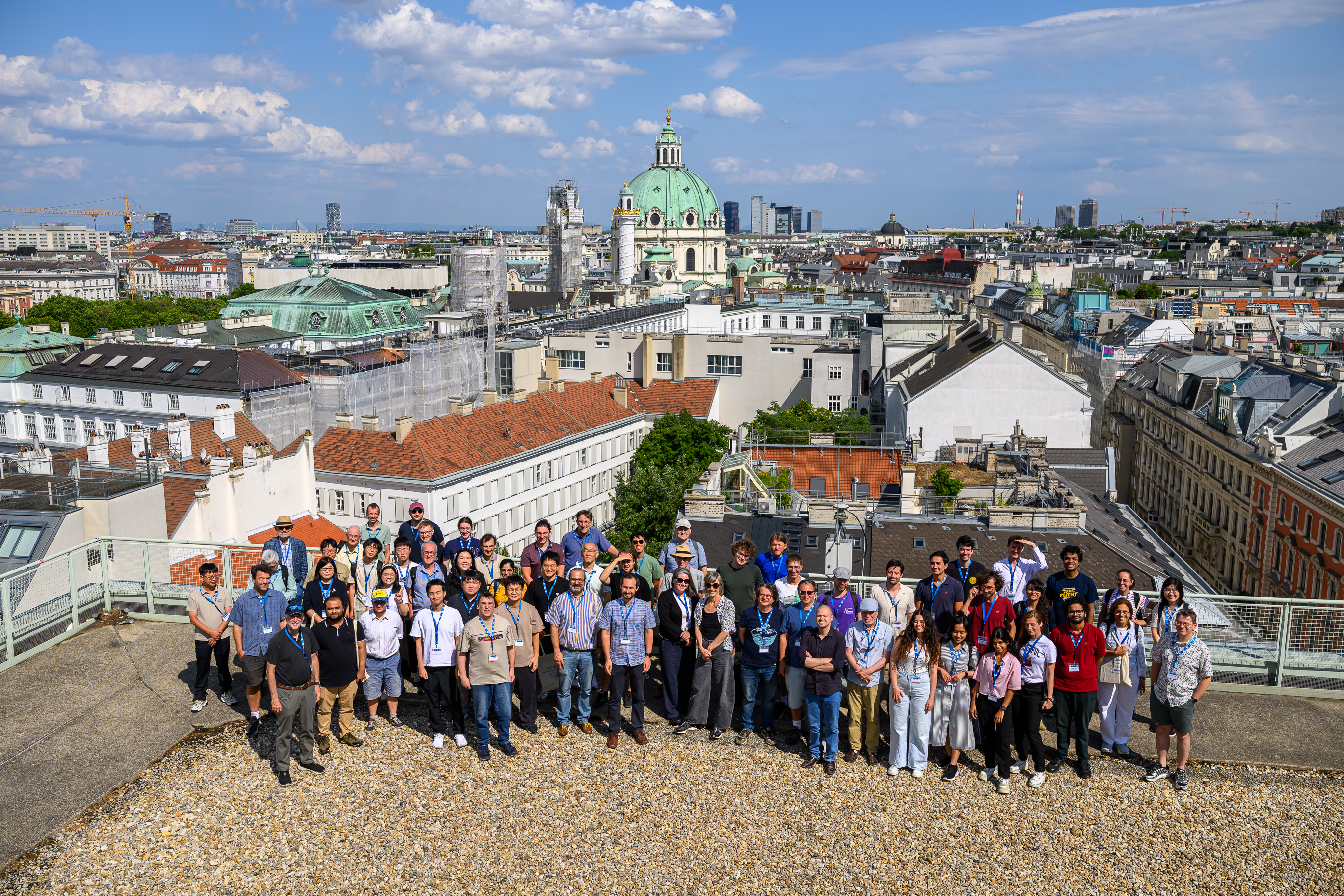
Group photo
Important dates
| Milestone | Date |
|---|---|
| Submissions opens | January 2026 |
| Registration opens | Mid-March 2026 |
| Talk and poster submission deadline | 15.05.2026 |
| Notification of acceptance | 31.05.2026 |
| Early bird registration ends | 15.06.2026 |
| Conference start | 20.07.2026 |
| Conference ends | 24.07.2026 |
Conference description


Lattice paths are fundamental objects that link a variety of fields of mathematics, computer science, and physics. The reason for their ubiquity is that they are well-suited to encode numerous objects (like random walks, continuous fractions, trees, planar maps, words, tilings...) and can reflect several aspects of these objects (q-analogues, critical exponents, conformal invariance, D-finiteness...). Thus, problems in various fields can be solved via the corresponding lattice path formulation.
Since lattice paths are — at the outset — reasonably simple combinatorial objects, the study of related probabilistic models is rich and attractive in its own right; this offers many formulas and challenging equations which are at the crossroads of several fields, forcing to develop new methods (like multivariate asymptotics, differential Galois theory, bijections, SLE, orthogonal polynomials, representation theory, heuristics from physics).
In recent years, interest in research on lattice paths has intensified, as it spurred the investigation of intriguing problems at the interface of such diverse areas as enumerative combinatorics, algebraic combinatorics, computer algebra, asymptotic combinatorics, probability theory, combinatorial physics.
The goal of this conference is to bring together leading researchers from these overlapping communities, to offer a panorama of discoveries made these last years. The main aim is to intensify the fruitful interactions between the researchers in these communities in order to make significant progress on the outstanding problems motivated by the combinatorics and analysis of lattice paths.
This conference constitutes the 10th "International Conference on Lattice Path Combinatorics & Applications". This series of conferences started in 1984 under the impulsion of Sri Gopal Mohanty. The 2026 conference will consist of 8 invited talks, 21 shorter talks, and a dozen of poster presentations, leaving time for scientific discussions.
For more details, we refer to the webpages on the history of the Lattice Path Conference and on the poster submissions and post-conference special issue.
Les chemins sur réseau sont des objets fondamentaux qui apparaissent dans de nombreux champs des mathématiques, de l’informatique et de la physique. Cette ubiquité s’explique par leur capacité à coder des objets combinatoires divers (marches, arbres, cartes, mots, pavages, fractions continuées) et à en réfleter différentes facettes (q-analogues, exposants critiques, invariance conforme, D-finitude). De multiples problèmes peuvent ainsi être formulés et résolus en termes de tels chemins.
Les chemins sur réseau étant, de prime abord, une structure simple et naturelle, l’étude des modèles probabilistes afférents est riche et débouche sur des équations et des formules qui mènent à des défis pluridisciplinaires, forçant le développement de nouvelles méthodes (en asymptotique multivariée, théorie de Galois différentielle, bijections, polynômes orthogonaux, théorie des représentations, processus SLE, heuristiques issues de la physique). Ces dernières années, l’intérêt pour ces objets a grandi et a mené à des problèmes intrigants, à l’interface de domaines variés, notamment en combinatoire énumérative, en combinatoire algébrique, en calcul formel, en combinatoire analytique, en théorie des probabilités, en physique combinatoire.
L’objectif de cette conférence est de réunir des experts internationaux issus de ces communautés, d’offrir un panorama des nombreuses découvertes des dernières années, et d’intensifier les interactions entre ces communautés, afin d’aboutir à de nouveaux progrès sur des problèmes de premier plan trouvant leur source dans la combinatoire des chemins.
Cet évènement constituera la dixième session de la série "International Conference on Lattice Path Combinatorics & Applications", initiée par Sri Gopal Mohanty en 1984. En 2026, la conférence proposera 8 exposés invités, 21 exposés courts et une dizaine de posters, laissant de surcroît du temps pour les échanges scientifiques.
Pour plus de détails, voir les pages sur l’histoire de la conférence et sur la soumission de poster et le numéro spécial consacré aux thématiques de la conférence.
Gitterwege sind grundlegende Objekte, die verschiedene Bereiche der Mathematik, Informatik und Physik miteinander verbinden. Ihre Allgegenwärtigkeit erklärt sich durch ihre Fähigkeit, zahlreiche kombinatorische Strukturen zu kodieren (wie Zufallswege, Kettenbrüche, Bäume, planare Karten, Wörter, Parkettierungen…) und verschiedene Aspekte dieser Objekte widerzuspiegeln (q-Analoga, kritische Exponenten, konforme Invarianz, D-Endlichkeit). Viele Probleme lassen sich daher in Form von Gitterwegen formulieren und lösen.
Da Gitterwege zunächst einfache und natürliche kombinatorische Strukturen darstellen, ist das Studium der zugehörigen probabilistischen Modelle reichhaltig und führt zu anspruchsvollen Gleichungen und Formeln, die an der Schnittstelle vieler Disziplinen liegen und die Entwicklung neuer Methoden erfordern (multivariate Asymptotik, Differential-Galois-Theorie, Bijektionen, SLE, orthogonale Polynome, Darstellungstheorie, heuristische Ansätze aus der Physik).
In den letzten Jahren hat das Interesse an der Forschung zu Gitterwegen stark zugenommen, da sie spannende Fragestellungen an der Schnittstelle von enumerativer, algebraischer, und asymptotischer Kombinatorik, Computeralgebra, Wahrscheinlichkeitstheorie und kombinatorischer Physik hervorgebracht hat. Ziel dieser Konferenz ist es, führende Forscherinnen und Forscher aus diesen überlappenden Bereichen zusammenzubringen und einen Überblick über die jüngsten Entwicklungen zu bieten.
Das Hauptziel besteht darin, die fruchtbaren Interaktionen zwischen diesen Gemeinschaften zu intensivieren, um wesentliche Fortschritte bei offenen Problemen zu erzielen, die durch die Kombinatorik und Analyse von Gitterwegen motiviert sind.
Diese Konferenz ist die zehnte Ausgabe der Reihe „International Conference on Lattice Path Combinatorics & Applications“, die 1984 von Sri Gopal Mohanty ins Leben gerufen wurde. Die Ausgabe 2026 umfasst 8 eingeladene Vorträge, 21 Kurzvorträge und etwa ein Dutzend Posterpräsentationen und lässt zudem Raum für wissenschaftliche Diskussionen.
Weitere Informationen finden sich auf den Seiten zur Geschichte der Lattice Path Conference sowie zur Postereinreichung und dem Sonderheft nach der Konferenz.
Sponsors